Feature
Max Ingrand – monde de la lumière


Max Ingrand (1908-1969) who was the artistic director at Fontana Arte between 1954-1964 and successor of Pietro Chiesa was the man of the impossible. Coming from a tradition of architectural glass design, especially large artisan glass panels and windows which were installed internationally, he became director of Fontana Arte and left a tremendous impact on the Italian company's oeuvre with his blend of experimentalism and tradition. His art was truly timeless and therefore never gets old. We have had some beautiful specimen over the last years and keep collecting.
“…the world of light is coming and it is up to us (...) to make it beautiful, noble…”
Max Ingrand
Max Ingrand Fontana Arte Glass Flush Mount(2), 1955
A pair of rare 36.6" semi glass flush-mounts
$ 41,000

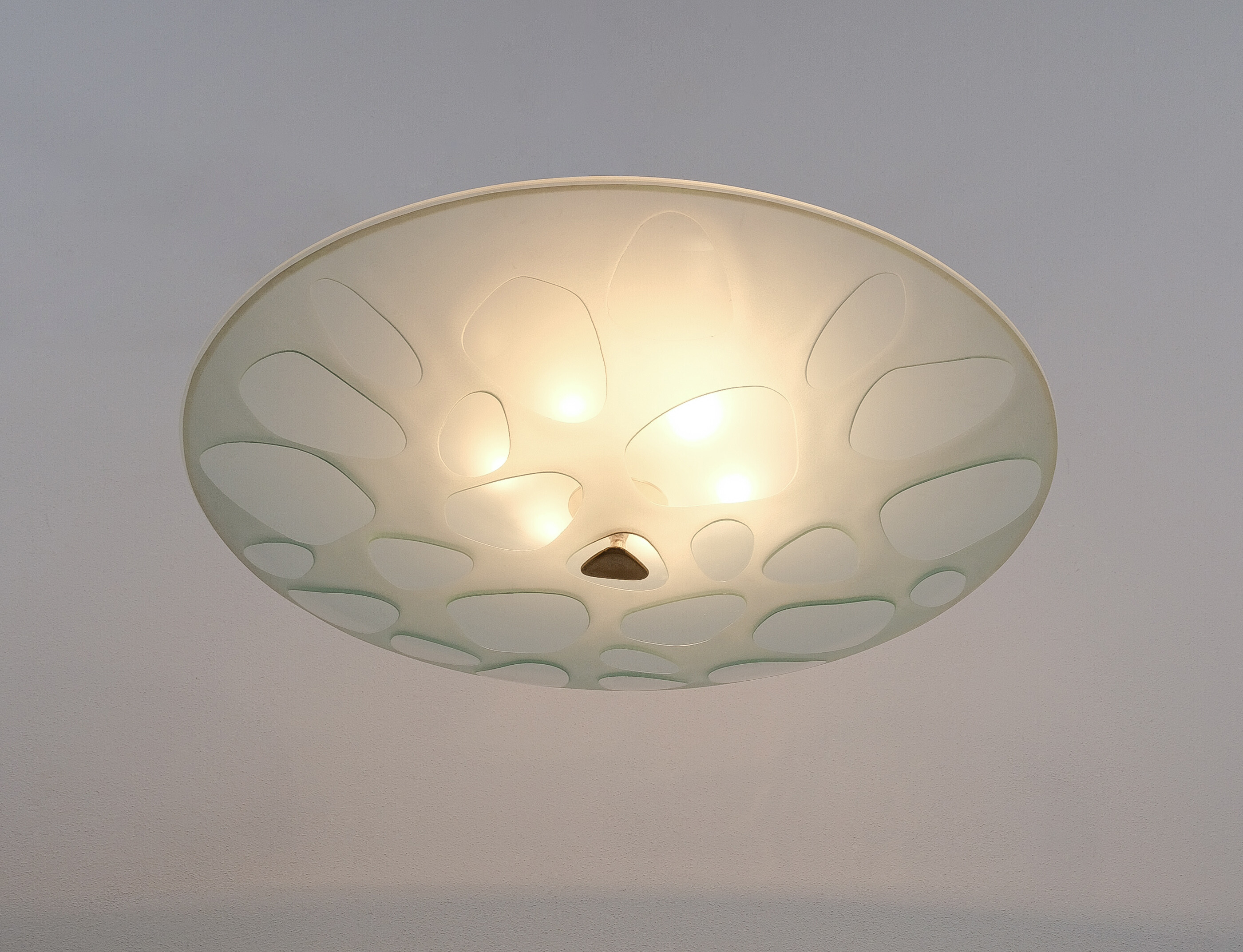

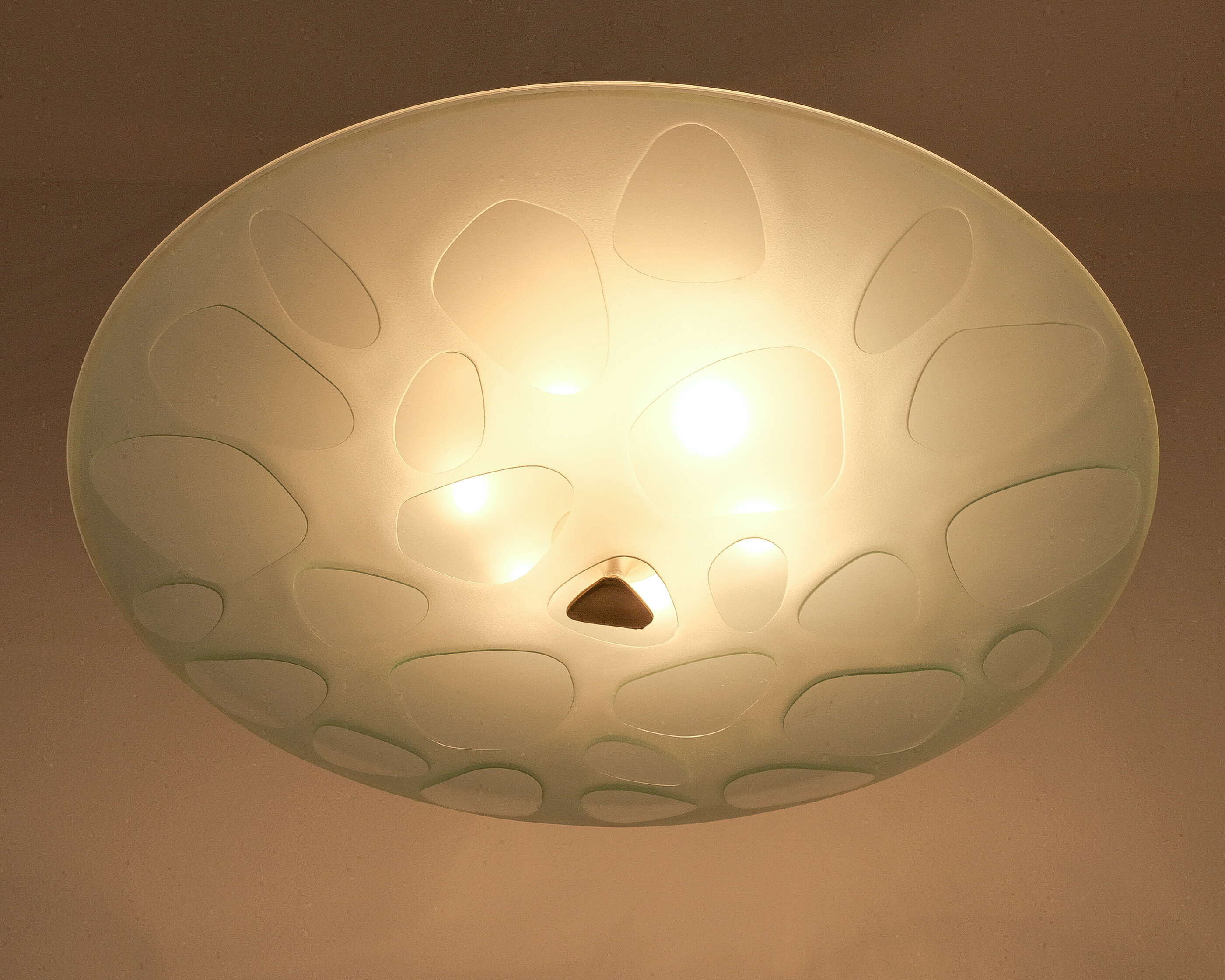
Max Ingrand Flush Mounts for Fontana Arte, 1957
Semi Glass Brass Flush Mount Mod. 1748
$ 22,000

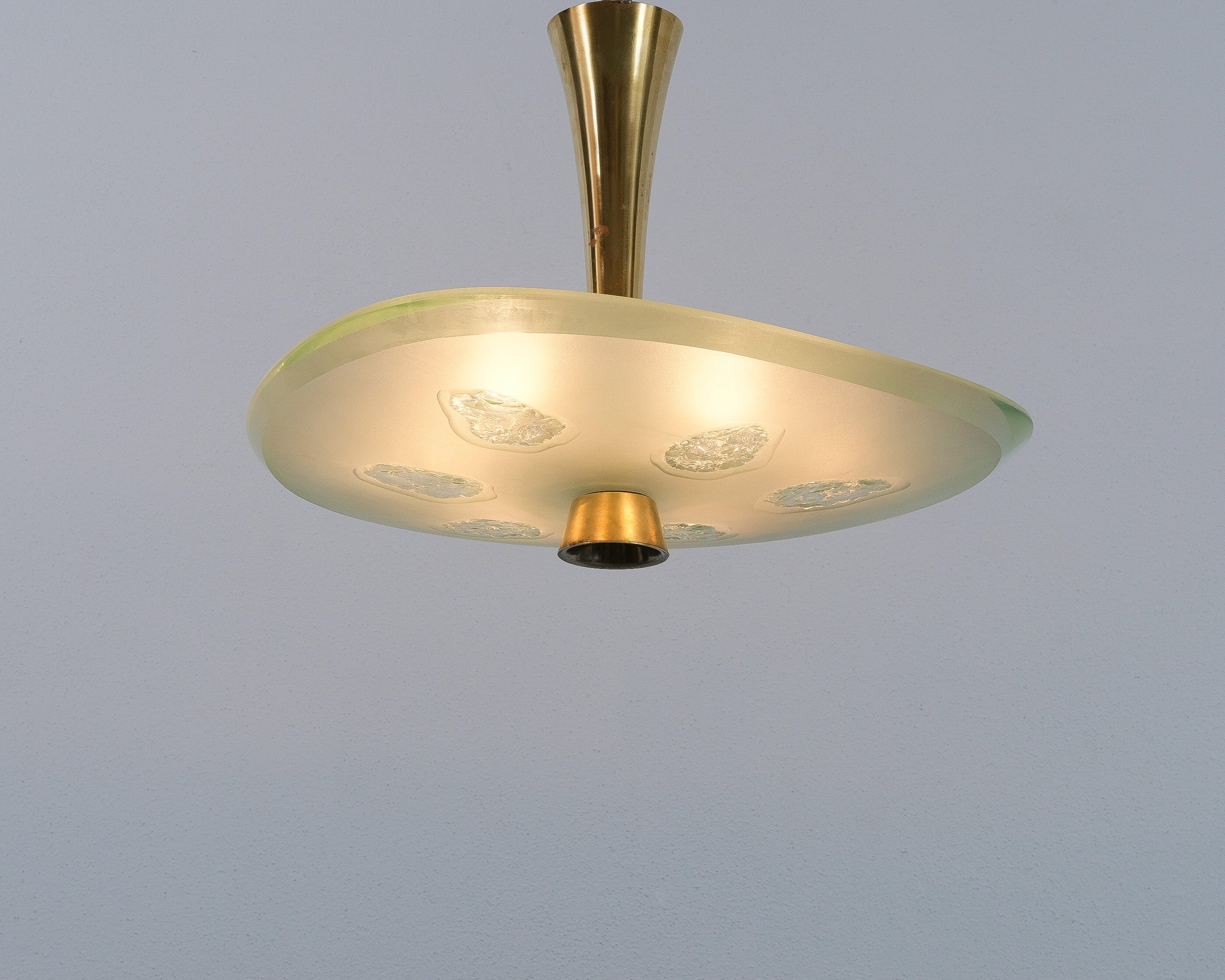


Wall Mirror Model 1657, Italy, circa 1958


Max Ingrand for Fontana Arte Semi Flush Mount, 1960


'Marked' Disco Volante Orange Glass Table Lamp Mod. 1538, Italy, 1955


Max Ingrand Fontana Arte Sconces mod. 1636, 1960
$ 11,000


Max Ingrand Wall Lights for Fontana Arte, 1960
$ 5,000


Glass Nickel Brass Sconces, Italy, 1960


Max Ingrand Fontana Arte Coffee Table Mod. 1774, Italy, circa 1958


Large Glass Flush Mount, Italy, Mid-Century Modern


Glass Pendant Lamp Light Model 1933


Max Ingrand Glass Brass Chandelier 2270, Italy 1960


Max Ingrand Opal Glass Lamp Mod. 2364


Max Ingrand Wall Lights For Fontana Arte, 1960
$ 30,000


Pair Blue Glass Sconces, Italy, 1960


Max Ingrand Pendant Lamp for Fontana Arte, 1960


Max Ingrand: Glass, Light, and Monumentality in Postwar Design
The career of Max Ingrand occupies a singular position within the history of twentieth-century design. Trained as a master glass artist and formed within the intellectual climate of French decorative arts, Ingrand navigated with unusual fluency between the domains of sacred art, interior decoration, and industrial lighting. His work reconciles craft and serial production, chromatic subtlety and structural rigor, monumentality and intimacy. While widely celebrated for his stained-glass windows in postwar ecclesiastical architecture, his contribution to modern lighting—particularly through his artistic direction of FontanaArte—remains central to his enduring legacy.
Formation and Early Practice
Born in 1908 in Bressuire, France, Ingrand studied at the École nationale supérieure des Arts Décoratifs in Paris, where he trained as a glass painter and decorator. This formation within the French decorative tradition grounded him in a culture that regarded ornament not as superficial embellishment but as an integral articulation of surface and structure. Early in his career, he established himself as a creator of stained-glass windows, working on numerous ecclesiastical commissions. These projects demanded a profound understanding of color, light transmission, and the interplay between material density and illumination—concerns that would later inform his lighting designs.
The experience of designing for sacred architecture sharpened Ingrand’s sensitivity to atmosphere. In the context of churches and chapels, light is both symbolic and spatial; it shapes contemplation, procession, and orientation. Ingrand approached glass as a mediator between natural light and architectural enclosure, calibrating transparency, opacity, and chromatic intensity. This sensibility—light as a metaphysical and architectural agent—remained fundamental throughout his career.
Artistic Direction at FontanaArte
In 1954, Ingrand was appointed artistic director of FontanaArte, succeeding the company’s earlier experimental phase associated with Gio Ponti. Founded in 1932 as a glass division of Luigi Fontana’s industrial enterprise, FontanaArte had already established a reputation for refined glass furnishings and lighting. Under Ingrand’s direction, however, the company underwent a decisive transformation. He consolidated its identity around luminous objects that combined technical innovation with sculptural presence.
Ingrand’s tenure at FontanaArte (1954–1967) coincided with a period of intense reconstruction and modernization in Italy. He responded not with austere minimalism but with a controlled opulence rooted in material intelligence. Thick crystal slabs, beveled edges, polished brass, and mirrored surfaces became recurring elements. Yet these materials were never deployed gratuitously. Instead, they were orchestrated to modulate light: to refract, diffuse, multiply, or soften its emission.
Chandeliers and wall sconces designed under his direction often reveal a stratified composition—outer diffusing shells encasing internal luminous cores. This layered construction echoes stained-glass logic, where multiple planes of glass interact with light at varying depths. Ingrand adapted such principles to electric illumination, translating ecclesiastical luminosity into domestic and public interiors.
Material Intelligence and Optical Refinement
A defining characteristic of Ingrand’s design language is his mastery of glass thickness and edge treatment. Heavy crystal panels with precisely ground bevels catch and refract light, producing subtle prismatic effects. These details are not decorative in a superficial sense; they are optical devices. By manipulating the geometry of edges and surfaces, Ingrand transformed static material into dynamic light-bearing architecture.
Mirrors also play a crucial role in his work. Reflective back panels amplify luminosity while visually dematerializing the supporting structure. This technique creates an interplay between object and environment: the lamp becomes both source and reflector, at once present and elusive. Brass components—often polished or satin-finished—provide structural clarity and chromatic warmth, counterbalancing the cool transparency of glass.
Ingrand’s approach differs markedly from the radical reduction pursued by some contemporaries. He did not seek to erase material presence but to choreograph it. His luminaires frequently possess a ceremonial quality, particularly in larger chandeliers whose concentric arrangements evoke classical order. Yet even in these more monumental works, proportion is carefully controlled. The mass of glass is balanced by precise suspension systems, ensuring visual equilibrium.
Dialogue with Italian Design Culture
Ingrand’s relocation to Milan and leadership at FontanaArte positioned him within the vibrant Italian design milieu of the 1950s and 1960s. The city fostered exchanges among architects, industrialists, and artists committed to redefining modern living. Within this context, Ingrand’s French training introduced a distinct sensibility—less overtly rationalist, more attuned to chromatic nuance and surface articulation.
His work entered into implicit dialogue with figures such as Gio Ponti, whose earlier involvement with FontanaArte had established the company’s commitment to elegance and innovation. While Ponti emphasized linear lightness and architectural integration, Ingrand deepened the exploration of glass as volumetric mass. The transition between these artistic directions illustrates the flexibility of Italian postwar design, capable of accommodating divergent yet complementary visions.
FontanaArte under Ingrand also collaborated with architects and interior designers who sought lighting solutions for hotels, offices, and public buildings. These commissions required scalability and technical reliability. Ingrand responded by refining production processes, ensuring that complex glass elements could be manufactured with consistency. The company thus maintained a delicate balance between artisanal craftsmanship and industrial repeatability.
Sacred Art and Secular Illumination
Parallel to his work in industrial design, Ingrand continued to produce stained-glass windows for churches in France and abroad. This dual practice—sacred and secular—reinforced his conceptual continuity. In both contexts, glass mediated light to produce atmosphere. The difference lay in scale and symbolism rather than in principle.
In ecclesiastical projects, color often assumed greater intensity, with deep blues and reds articulating narrative iconography. In domestic lighting, chromatic restraint prevailed: smoked, amber, or lightly tinted glass introduced warmth without overwhelming interior schemes. The disciplined use of color reveals Ingrand’s awareness of context. He understood that lighting must coexist with furnishings, architecture, and human presence.
Formal Typologies and Iconic Models
Among Ingrand’s most significant contributions are his chandelier designs, characterized by radial symmetry and layered glass elements. These compositions reinterpret historical typologies—such as the classical chandelier—through the lens of modern materiality. Instead of crystal pendants suspended from ornate frames, Ingrand employed geometric discs, panels, or prisms arranged in ordered constellations. The resulting effect is at once contemporary and resonant with tradition.
Wall sconces and table lamps from his period at FontanaArte often display a similar structural logic: a glass diffuser mounted on a reflective or metallic support, producing indirect light. This strategy enhances visual comfort while accentuating the material qualities of glass. The illumination appears enveloped rather than exposed, generating a calm, diffused radiance.
International Reach and Recognition
Ingrand’s reputation extended beyond Italy and France. His lighting fixtures were exported widely, contributing to the international dissemination of Italian design during the postwar economic expansion. Exhibitions and trade fairs reinforced his standing as a leading figure in modern glass-based lighting.
Yet his success did not lead to stylistic stagnation. Over the course of his tenure at FontanaArte, subtle shifts can be observed: from more decorative compositions toward increasingly refined geometries. This evolution reflects both technological developments and changing aesthetic climates. By the late 1960s, the design world was gravitating toward greater minimalism. Ingrand’s departure from FontanaArte in 1967 marked the end of a particularly opulent yet disciplined chapter in the company’s history.
Legacy and Position within Design History
Max Ingrand’s contribution lies in his synthesis of decorative arts tradition and modern industrial production. He neither rejected ornament outright nor embraced it uncritically. Instead, he redefined ornament as optical function: bevels, thicknesses, and reflective planes became instruments for shaping light.
Within the broader narrative of twentieth-century design, Ingrand stands as a mediator between epochs. His stained-glass windows connect him to centuries-old craft practices, while his lighting fixtures belong unmistakably to the modern interior. The continuity between these realms underscores his conviction that light is the true protagonist of spatial experience.
Today, his works are held in significant collections and remain highly sought after. Their appeal resides not merely in historical value but in enduring spatial efficacy. Ingrand’s luminaires continue to produce atmospheres of measured elegance, their interplay of glass and metal retaining clarity and resonance.
The Architecture of Luminosity
Max Ingrand approached design as an architecture of luminosity. Whether filtering daylight through colored panes or modulating electric illumination within crystal volumes, he treated glass as a structural and poetic medium. His leadership at FontanaArte consolidated a language of refined monumentality, where material density and radiant light coexist in equilibrium.
Ingrand’s legacy endures in the quiet authority of his objects. They do not proclaim innovation; they embody it through proportion, craft, and optical intelligence. In shaping glass to shape light, he defined a chapter of postwar design in which tradition and modernity were not adversaries but collaborators in the pursuit of luminous form.