Feature
Gino Sarfatti - Master and Servant

Gino Sarfatti the unknown master
Gino Sarfatti (1912–1985) stands as one of the great intelligences of twentieth-century lighting design. Trained initially as an aeronautical engineer, he brought an analytical, almost scientific clarity to the question of light—treating it not as ornament, but as a technical and spatial problem to be solved with elegance and precision. Over the course of his career he designed more than 600 lamps, each marked by an exceptional balance between innovation and restraint.
Sarfatti’s genius lies in his ability to merge advanced engineering with a refined visual language. He was among the first to experiment systematically with new materials—aluminium, plastics, halogen bulbs—always in service of function, never novelty. His forms are lucid and purposeful, yet quietly poetic, anticipating both industrial rationalism and the later language of Italian modernism. In Sarfatti’s work, light becomes architecture: calibrated, intelligent, and profoundly modern.
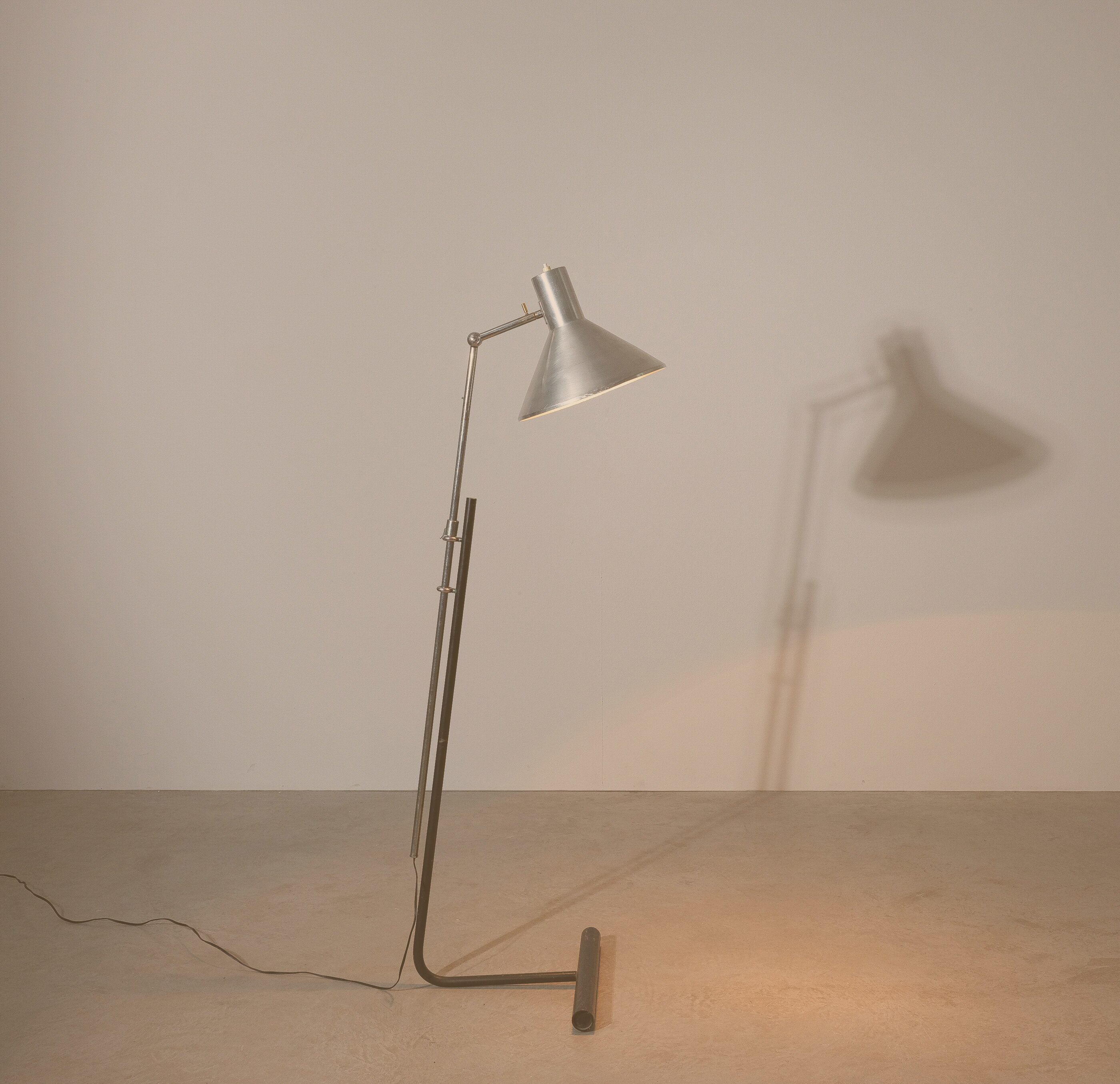
Gino Sarfatti Floor Lamp for Arteluce, 1948
Adjustable Floor Lamp Mod. 1045, Italy
$ 17,900


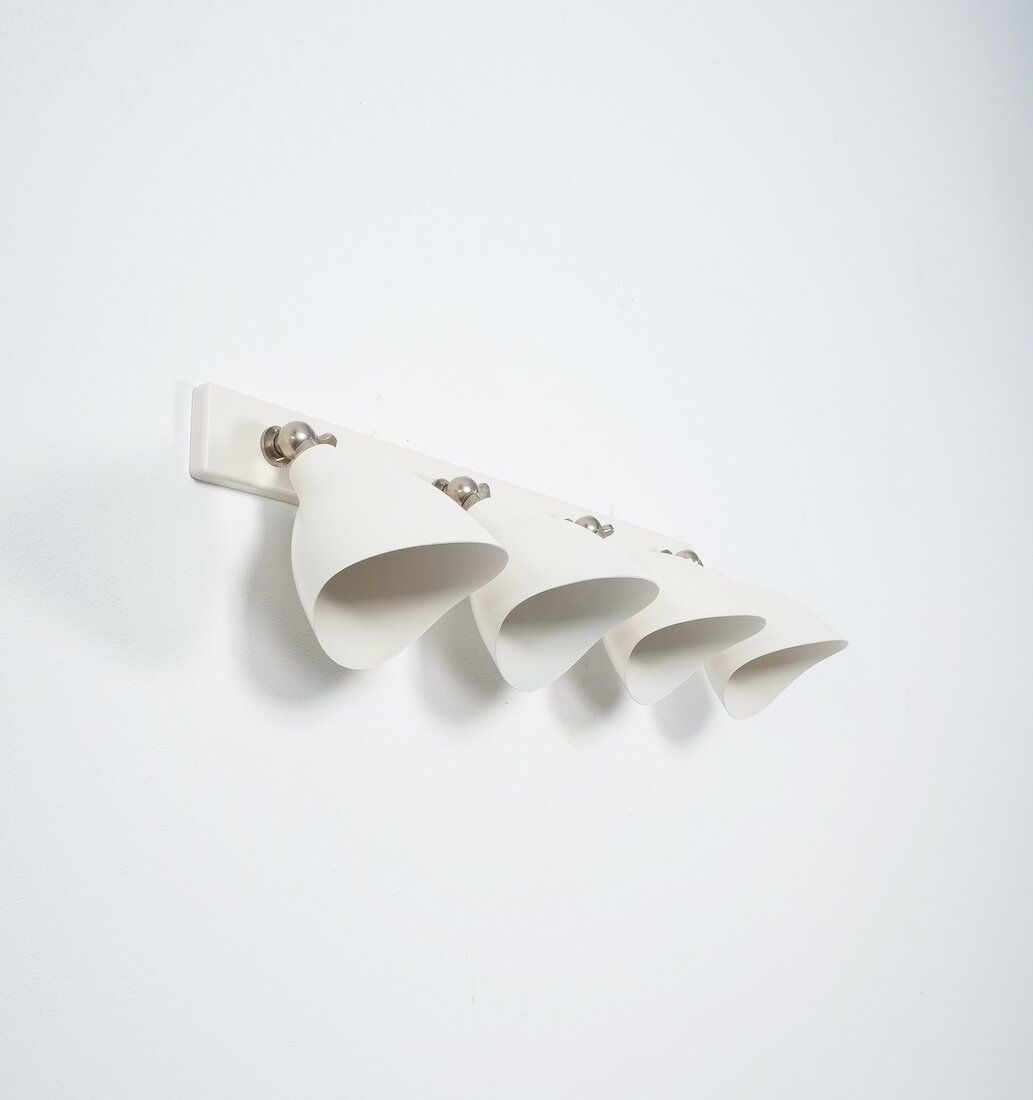
Mod. 113b Pair Refurbished Large Articulate Sconces, 1950
$ 6,900


Gino Sarfatti outdoor lights model 1102 for Arteluce, Italy, 1971
Very rare pair of Gino Sarfatti outdoor lights model 1102 for Arteluce from 1971.
$ 14,000


Gino Sarfatti for Arteluce Model 194n, 1950
Wall-Mounted Pendant Lamps
$ 7,500


Gino Sarfatti for Arteluce Glass Pendants, 1960
Seguso Bubble Glass
$ 5,500


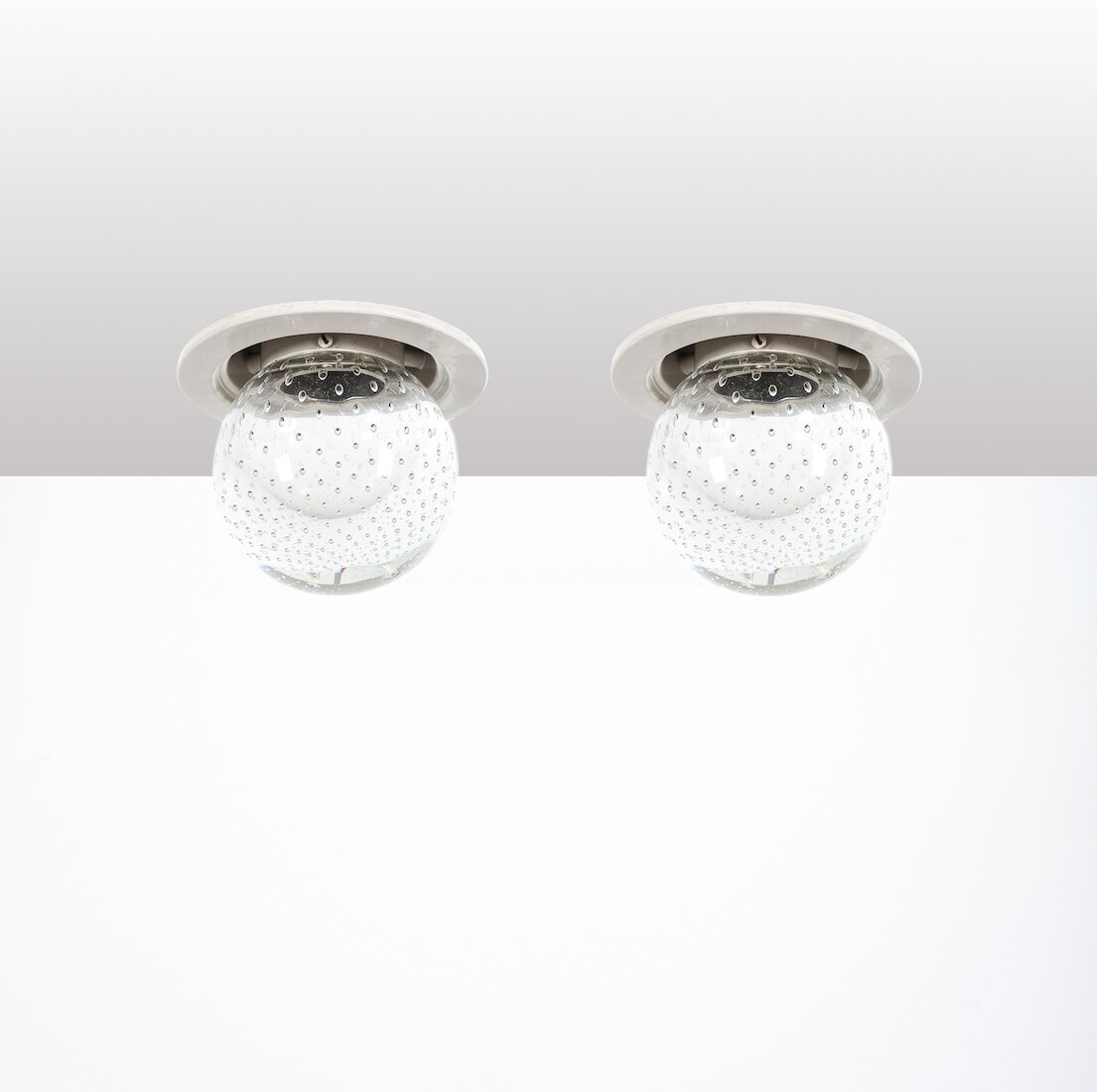
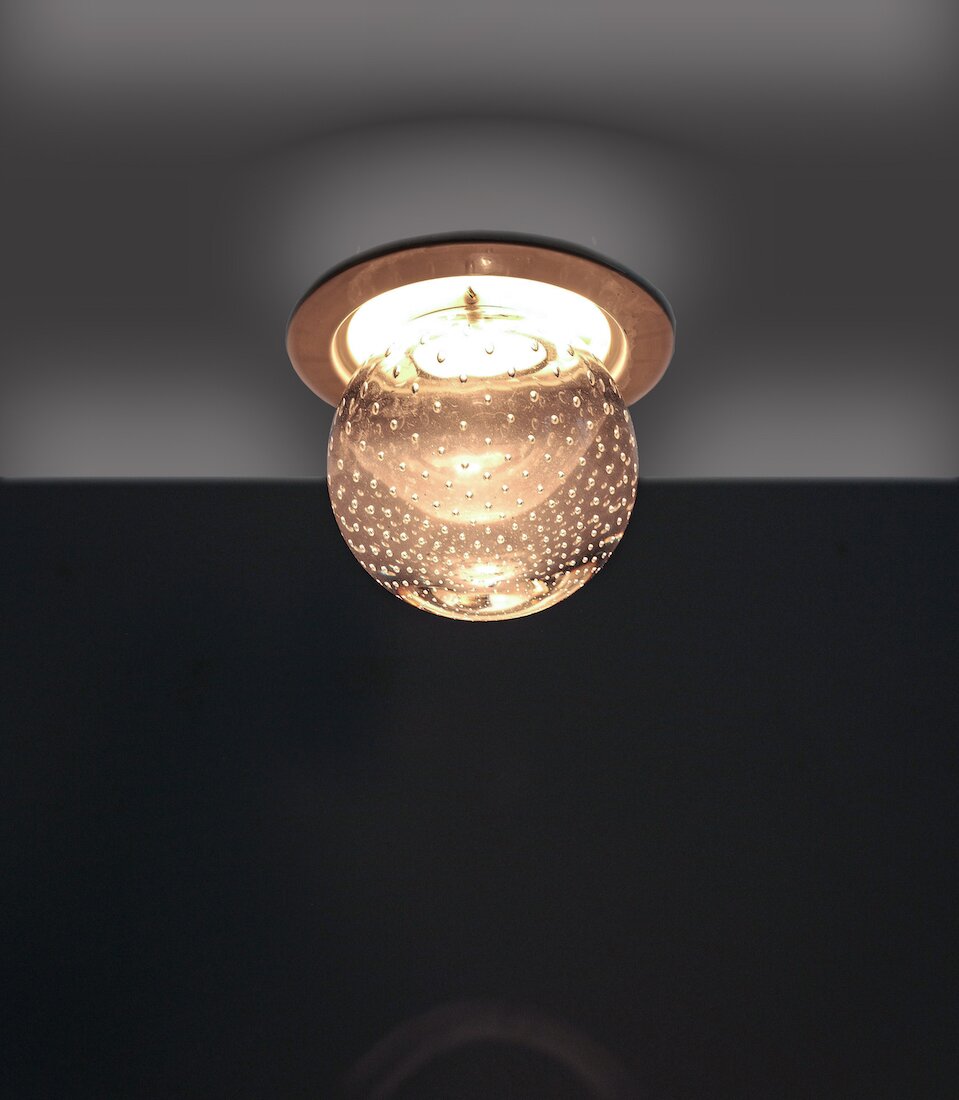
Gino Sarfatti Flush Mounts Recessed Lights Pair SP/16 For Arteluce, 1962


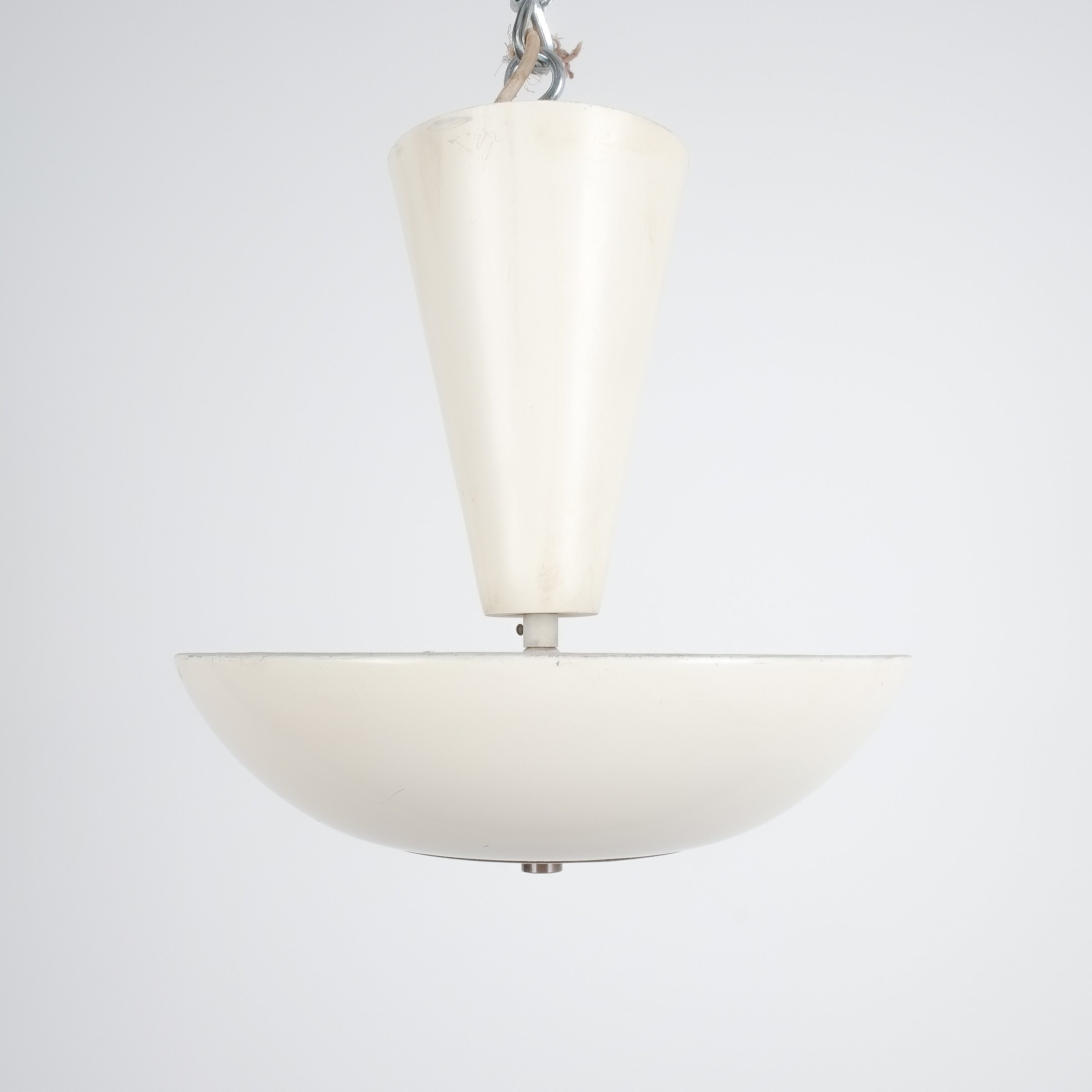
3003 Ceiling Lamp or Semi Flush Mount Pair, Italy, 1950


The history of twentieth-century lighting design cannot be written without sustained attention to Gino Sarfatti, whose work decisively redefined the typology, technology, and expressive range of the modern luminaire. Born in Venice in 1912 and trained initially in aeronaval engineering in Genoa, Sarfatti did not follow the conventional path of the architect-designer. Instead, he approached lighting as a field of technical and spatial experimentation, guided less by stylistic allegiance than by an analytical understanding of materials, optics, and construction. In 1939, he founded Arteluce in Milan, a company that would become both laboratory and platform for over 700 lighting models, many of which remain paradigmatic within the canon of modern design.
Engineering as Design Method
Sarfatti’s education in engineering proved decisive. Rather than conceiving light fixtures as ornamental adjuncts to architecture, he treated them as technical instruments embedded in space. This distinction is crucial. In Sarfatti’s work, structure is not disguised but articulated; the logic of assembly becomes part of the visual language. Metal tubes, articulated joints, counterweights, reflectors, and wiring systems are handled with clarity and precision. The result is an aesthetic of rational elegance, in which form arises from performance.
From the outset, Sarfatti was attentive to emerging technologies. He experimented with halogen sources, low-voltage systems, and innovative reflector geometries long before such features became widespread. He understood that lighting design operates at the intersection of physics and perception: the distribution, diffusion, and direction of light fundamentally shape spatial experience. Consequently, his lamps often display a refined balance between direct and indirect illumination, shielding glare while maximizing luminous efficiency.
This technical acuity did not produce cold functionalism. On the contrary, Sarfatti’s designs are marked by a subtle sensibility toward proportion and rhythm. Whether in multi-arm chandeliers or minimal wall sconces, the equilibrium of mass and void is carefully calibrated. His work resists overt monumentality; instead, it achieves presence through structural poise.
The Founding and Ethos of Arteluce
When Sarfatti established Arteluce in Milan in 1939, he created more than a manufacturing enterprise. Arteluce functioned as a research-driven atelier, combining artisanal craft with industrial serial production. Situated in a city that would soon emerge as the epicenter of Italian design culture, the company quickly became a point of convergence for architects, designers, and critics interested in the future of modern living.
Arteluce distinguished itself through its rigorous attention to detail and its willingness to innovate technologically. The company participated regularly in the Milan Triennale, where Sarfatti’s designs received multiple awards, consolidating his international reputation. Importantly, Arteluce maintained control over both design and production, allowing Sarfatti to test prototypes, refine components, and adjust technical specifications with unusual autonomy. This integration of design thinking and manufacturing capability enabled a continuity between concept and realization rarely achieved in larger industrial contexts.
Arteluce’s catalog reveals remarkable typological breadth: ceiling-mounted systems, wall sconces, table lamps, floor lamps, and complex modular arrangements. Yet despite this diversity, a coherent philosophy persists. The lamp is conceived as an adaptable device, responsive to changing domestic and professional environments. Arteluce fixtures often incorporate adjustable arms, pivoting heads, or modular extensions, anticipating contemporary notions of flexible space.
Formal Reduction and Structural Expression
In the 1950s and 1960s, Sarfatti developed some of his most celebrated models. Multi-light chandeliers with radiating arms exemplify his ability to transform technical necessity into sculptural composition. The exposed bulbs, frequently arranged in rhythmic constellations, foreground the source of illumination itself. Rather than concealing the bulb behind heavy ornamentation, Sarfatti integrated it into the formal system, emphasizing clarity and repetition.
This strategy aligns him with broader currents in Italian modernism, yet his work remains distinct from the more overtly expressive tendencies of certain contemporaries. Where others sought dramatic gestures, Sarfatti pursued measured refinement. The interplay of brass, aluminum, lacquered steel, and glass is handled with restraint. Surfaces are polished or satin-finished to modulate reflection without excessive sheen. Even when employing luxurious materials, he avoided rhetorical excess.
A key aspect of his design language is modularity. Many Arteluce fixtures can be expanded or reconfigured, their arms extended or rearranged to suit spatial requirements. This anticipates later developments in systems design and reflects Sarfatti’s engineering mindset: the lamp as an open structure rather than a fixed object.
Collaboration and Dialogue
Although Sarfatti is often regarded as the central creative force behind Arteluce, the company also fostered significant collaborations. Arteluce worked with leading architects and designers, such as Ico Parisi, Franco Albini, Massimo Vignelli and Carlo Molino who shared an interest in modern spatial concepts.
These collaborations were not merely commercial arrangements; they constituted intellectual exchanges. Viganò’s architectural rigor and attention to structural articulation resonated with Sarfatti’s own priorities. Zanuso’s sensitivity to industrial production and new materials paralleled the experimental ethos of Arteluce. Within this milieu, lighting became a medium through which broader questions of modern life—flexibility, transparency, technological progress—could be explored.
Arteluce also interacted with the wider constellation of Italian design culture, including manufacturers such as Olivetti, whose corporate identity foregrounded design excellence and innovation. While Sarfatti did not design for Olivetti directly in the manner of some contemporaries, the shared climate of interdisciplinary exchange in postwar Italy shaped his outlook. Milan in the 1950s was characterized by porous boundaries between architecture, industrial design, and graphic communication. Arteluce thrived within this environment.
Light as Spatial Agent
Central to Sarfatti’s legacy is his understanding of light as an architectural agent. He recognized that illumination defines atmosphere, articulates surfaces, and structures perception. His fixtures frequently direct light upward to generate indirect ambient glow, or downward through calibrated reflectors to produce focused pools of brightness. In both cases, the luminaire acts as mediator between source and space.
The careful management of glare is particularly noteworthy. Sarfatti developed reflector systems and diffusing elements that shield the eye while preserving luminous intensity. This technical refinement contributes to the enduring usability of his designs. They are not merely historical artifacts but remain functionally convincing in contemporary interiors.
Moreover, Sarfatti’s lamps often embody a tension between visibility and dematerialization. Slender stems and attenuated arms reduce visual weight, allowing the illuminated volumes to appear suspended. In certain models, the supporting structure recedes into near-invisibility, emphasizing the primacy of light itself. Such effects reveal a nuanced understanding of perception, bordering on phenomenological inquiry.
International Recognition and Awards
Throughout his career, Sarfatti received numerous accolades, including multiple Compasso d’Oro awards, affirming his influence within Italian design discourse. Arteluce fixtures were exhibited widely, entering museum collections and international markets. The company became synonymous with technical excellence and refined modernism.
Yet Sarfatti remained committed to experimentation rather than self-repetition. Over three decades, he continuously revised his approach in response to new technologies and shifting cultural contexts. The introduction of halogen lighting, for example, prompted fresh investigations into compact, high-intensity sources and new reflector geometries. Rather than treating innovation as superficial novelty, he integrated it structurally into his designs.
The Sale of Arteluce and Later Legacy
In 1973, Sarfatti sold Arteluce to Flos, marking the end of an era. By that time, Arteluce had already secured its place in design history. The acquisition ensured that many of Sarfatti’s models would continue in production, extending their influence into subsequent generations.
The decision to sell can be understood within the broader transformation of Italian industry during the 1970s, as smaller, founder-led firms were absorbed into larger corporate structures. Nevertheless, Sarfatti’s impact persisted, both through the continued circulation of his designs and through the methodological precedent he established: rigorous engineering integrated with aesthetic clarity.
Today, his lamps are represented in major design collections and remain highly sought after in the vintage market. Their enduring appeal lies not in nostalgia but in structural coherence. They address perennial questions—how to illuminate a table, a ceiling, a wall—with solutions that remain convincing decades later.
Position within Italian Modernism
Situating Sarfatti within Italian modernism requires attention to his distinctive balance of rationalism and subtle lyricism. He shared with contemporaries a commitment to industrial progress and clarity of form, yet his focus on lighting gave his work a particular intimacy. Whereas furniture designers grappled with mass and volume, Sarfatti engaged with immaterial radiance. His medium was ephemeral, yet he grounded it in precise mechanics.
In contrast to more overtly expressive designers, Sarfatti avoided dramatic formal gestures. His restraint reflects an ethical dimension: a belief that design should serve human use without theatrical excess. This ethos aligns with postwar aspirations toward reconstruction and modernization, where clarity and efficiency were imbued with cultural significance.
A Discipline Defined
Gino Sarfatti transformed lighting from a subsidiary craft into a discipline of architectural and industrial consequence. Through Arteluce, he established a model of practice in which research, design, and production were seamlessly integrated. His collaborations with architects and designers enriched this endeavor, embedding his luminaires within broader spatial and cultural frameworks.
Above all, Sarfatti demonstrated that light—intangible, transient—could be shaped with intellectual rigor. His lamps articulate structure without heaviness, distribute illumination without glare, and embody modernity without dogmatism. In doing so, they continue to illuminate not only interiors but also the history of design itself.